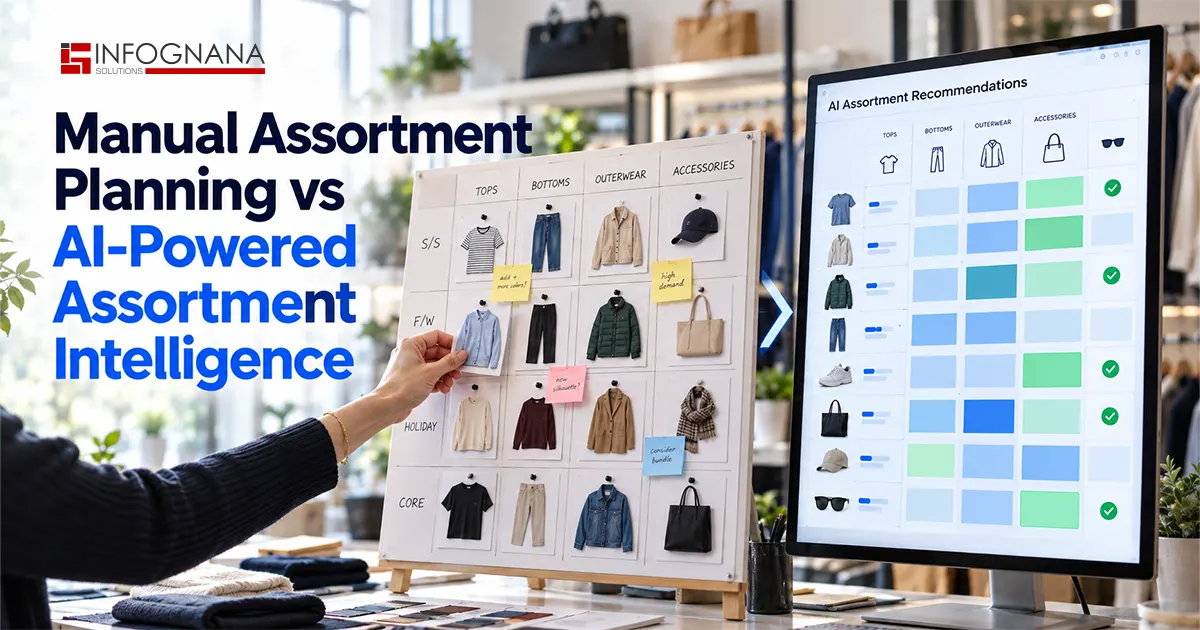
Retailers must make critical decisions about which products to stock, how much inventory to maintain, and how to respond to changing customer demand. These decisions directly influence sales, profitability, inventory costs, and customer satisfaction.
Traditionally, businesses have relied on spreadsheets, historical sales reports, and the experience of merchandising teams to plan their product assortments. While manual assortment planning can work for smaller product ranges, it becomes increasingly challenging as retailers expand across multiple stores, ecommerce platforms, and product categories.
AI-powered assortment intelligence offers a more data-driven approach. By analyzing sales trends, inventory levels, customer preferences, and demand signals, AI-powered systems help retailers identify product opportunities and make more informed assortment decisions.
But does AI-powered assortment intelligence completely replace manual planning? Not necessarily. The right approach depends on business size, data availability, operational complexity, and planning objectives.
In this article, we compare manual assortment planning with AI-powered assortment intelligence, explore their key differences, and explain how retailers can choose the right strategy to improve inventory performance and support business growth.
What Is Manual Assortment Planning?
Manual assortment planning is a traditional retail process in which merchandising and buying teams select products based primarily on historical sales data, spreadsheets, market research, and professional judgment.
Retail teams review previous sales performance, evaluate product categories, estimate future demand, and decide which products to stock for upcoming seasons or sales periods.
For example, a fashion retailer may review last year’s summer sales to determine which clothing styles, colors, and sizes to purchase for the next season.
Manual planning can be effective when product ranges are manageable, demand patterns are relatively stable, and experienced buyers have sufficient time to analyze the available information.
However, the process becomes more difficult when retailers must manage thousands of stock-keeping units (SKUs), multiple sales channels, changing customer preferences, and frequent inventory fluctuations.
Key Characteristics of Manual Assortment Planning
- Relies heavily on historical sales reports and spreadsheets.
- Uses buyer experience and merchandising judgment.
- Often follows seasonal or periodic planning cycles.
- Requires manual data collection and analysis.
- May use broad product or store categories rather than detailed demand patterns.
- Depends on individual teams to identify underperforming products and inventory risks.
Although manual planning provides flexibility and human control, its effectiveness depends on the quality of the data, the experience of the team, and the time available for analysis.
What Is AI-Powered Assortment Intelligence?
AI-powered assortment intelligence uses artificial intelligence, machine learning, predictive analytics, and optimization techniques to help retailers make better product assortment decisions.
Instead of relying exclusively on historical reports and manual analysis, these systems can process large datasets to identify patterns, forecast demand, evaluate product performance, and recommend assortment changes.
Depending on the platform, relevant data may include sales transactions, inventory availability, product attributes, customer behavior, promotional activity, supplier lead times, and ecommerce engagement.
For example, an ecommerce retailer may use assortment intelligence to identify products with increasing demand, detect overlapping product variations, and recommend which items deserve greater inventory investment.
Key Capabilities of AI-Powered Assortment Intelligence
- Demand forecasting: Estimates future product demand using historical and relevant current data.
- Product performance analysis: Identifies high-performing and slow-moving products.
- Assortment optimization: Recommends product selections based on business objectives and customer demand.
- Inventory risk detection: Flags potential overstock and stockout situations.
- Customer demand analysis: Identifies patterns in purchasing behavior and product preferences.
- Scenario analysis: Helps compare possible assortment decisions before implementation.
- Continuous monitoring: Supports more frequent reviews as new performance data becomes available.
AI-powered assortment intelligence helps teams move from reviewing past performance toward making more informed decisions about future demand.
However, the quality of its recommendations depends on reliable data, suitable models, business constraints, and human oversight.
Manual Assortment Planning vs AI-Powered Assortment Intelligence: Key Differences
The primary difference lies in how retailers collect information, evaluate products, and make assortment decisions.
| Comparison Factor | Manual Assortment Planning | AI-Powered Assortment Intelligence |
|---|---|---|
| Data Analysis | Spreadsheets and manual reports | Automated analysis of connected datasets |
| Decision-Making | Buyer experience and historical trends | Predictive insights combined with business judgment |
| Planning Speed | Can be time-consuming at scale | Can accelerate analysis and recommendations |
| Demand Forecasting | Often relies on historical averages and manual estimates | Can use predictive models and multiple demand signals |
| Product Selection | Based on periodic reviews and team decisions | Supported by product performance analysis and optimization |
| Inventory Risk | Identified through reports and manual checks | Can flag potential risks using configured models and thresholds |
| Assortment Personalization | Often uses broad store or customer segments | Can support more granular store, channel, and segment recommendations |
| Scalability | Requires more manual effort as complexity grows | Can process larger datasets when infrastructure supports it |
| Adaptability | Changes depend on review schedules and staff availability | Can support more frequent reassessment |
| Human Involvement | High across data gathering and analysis | Focus shifts toward reviewing recommendations and handling exceptions |
| Initial Investment | May require fewer new technology investments | May require software, integration, data preparation, and training |
| Governance | Depends on established planning procedures | Requires model oversight, data controls, and approval workflows |
The comparison is not absolute. Well-designed manual processes can be highly effective, while poorly implemented AI systems can produce unreliable recommendations. The objective is to improve decision quality rather than automate decisions without oversight.
Five Limitations of Manual Assortment Planning
1. Time-Consuming Data Analysis
Retail teams may need to collect sales reports, inventory records, supplier information, and ecommerce data from different systems.
Combining and reviewing this information manually takes time, particularly when businesses manage large product catalogs.
As a result, buyers may have less time to evaluate emerging trends, explore new product opportunities, and improve category performance.
2. Limited Ability to Respond to Demand Changes
Customer preferences can change because of seasonality, promotions, competitor activity, and emerging trends.
If assortment decisions are reviewed only at fixed intervals, retailers may not identify these changes quickly enough.
This can lead to excess inventory for declining products and insufficient stock for products experiencing increased demand.
3. Higher Risk of Overstock and Stockouts
Manual planning can make it difficult to balance product variety, purchasing budgets, and expected demand across multiple locations.
Overestimating demand can result in unsold inventory and markdowns. Underestimating demand can cause stockouts and lost sales.
These risks become more difficult to manage as the number of products and sales channels increases.
4. Difficulty Managing Large Product Catalogs
Retailers with thousands of SKUs may struggle to evaluate every product variation consistently.
Differences in size, color, price, brand, and product attributes can create additional complexity.
Without suitable analytical support, teams may overlook slow-moving products, duplicated assortment options, or emerging sales opportunities.
5. Limited Visibility Across Sales Channels
Retailers selling through physical stores, ecommerce websites, and marketplaces need a consistent view of product performance.
When sales and inventory data remain disconnected, teams may struggle to determine where products perform best or where inventory should be allocated.
This can lead to inconsistent assortment decisions and inefficient inventory utilization.
How AI-Powered Assortment Intelligence Improves Retail Performance
1. Makes Product Selection More Data-Driven
AI-powered assortment intelligence analyzes product performance, demand patterns, and relevant business constraints to support product selection.
For example, an electronics retailer may identify accessories that generate strong margins and consistent demand, while other products receive little customer interest despite occupying valuable inventory space.
These insights help merchandising teams evaluate which products to expand, retain, reduce, or discontinue.
Business impact: Better-informed product selection and more effective use of inventory investment.
2. Helps Reduce Overstock and Excess Inventory
By combining historical sales, current stock levels, and demand forecasts, AI-powered systems can flag products that may accumulate excess inventory.
Retail teams can review these alerts before placing new orders or making replenishment decisions.
For example, a home goods retailer may identify seasonal decorations with declining demand and adjust future purchasing quantities accordingly.
Business impact: Potential reductions in excess stock, storage costs, and markdown pressure.
3. Improves Product Availability
AI-powered assortment intelligence can help identify products that are likely to experience increased demand or become unavailable.
When integrated with inventory planning and replenishment workflows, these insights can help retailers prioritize stock allocation and purchasing decisions.
For example, a grocery retailer may use local sales patterns and seasonal demand signals to identify stores that need additional quantities of selected products.
Business impact: Better inventory availability and fewer avoidable stockouts.
4. Supports Store-Specific Assortment Decisions
Customer preferences differ across locations, store formats, and online channels.
AI-powered systems can analyze these differences and recommend assortments that better reflect the demand patterns of each market.
For example, an apparel retailer may prioritize different clothing styles across stores based on observed sales, local preferences, and seasonal requirements.
Business impact: More relevant product assortments and improved inventory allocation.
5. Helps Identify Emerging Product Opportunities
AI can analyze product attributes, sales trends, search behavior, and other available signals to identify categories or products worth investigating.
These insights can help buyers discover gaps in the existing assortment and evaluate opportunities to introduce new products.
However, new-product recommendations should be assessed carefully because limited sales history can make demand forecasts less reliable.
Business impact: More informed assortment expansion and product development decisions.
Practical Example: Manual Planning vs AI-Powered Planning
Consider an online retailer managing 5,000 SKUs across several product categories.
Under a manual approach, the merchandising team reviews monthly sales reports, checks inventory spreadsheets, and uses previous purchasing patterns to plan future orders.
The team identifies some slow-moving products, but the analysis takes considerable time. Meanwhile, certain popular products experience stockouts before the next planning review.
With AI-powered assortment intelligence, the retailer connects relevant sales and inventory data to an analytical platform.
The system identifies products with declining sales, flags potential inventory risks, and recommends products for further review based on demand and profitability.
The merchandising team evaluates these recommendations, considers supplier constraints, and approves appropriate changes to purchasing and assortment plans.
The two approaches can be compared as follows:
| Planning Activity | Manual Approach | AI-Powered Approach |
|---|---|---|
| Review Product Performance | Staff compile and analyze reports | Automated analysis highlights patterns |
| Identify Slow-Moving Products | Buyers review sales and inventory manually | Configured analytics flag underperforming items |
| Anticipate Demand | Buyers use historical trends and judgment | Predictive models estimate future demand |
| Evaluate Assortment Changes | Teams compare options manually | Systems can support scenario analysis |
| Make Final Decisions | Buyers approve changes | Buyers review recommendations and approve changes |
The AI-powered approach can accelerate analysis, but results depend on the reliability of the underlying data and the team’s ability to act on recommendations.
The retailer should measure the actual impact through inventory turnover, stockout rates, markdowns, sales, and gross margins rather than assuming that adopting AI will automatically improve every metric.
Key Benefits of AI-Powered Assortment Intelligence
Improved Inventory Efficiency
More informed assortment decisions can help retailers reduce excess inventory and direct purchasing budgets toward products with stronger demand potential.
Better Sales Opportunities
Improved product availability and more relevant assortments can help retailers meet customer demand and reduce missed sales opportunities.
Higher Merchandising Productivity
Automating repetitive analysis allows buyers and category managers to spend more time on product strategy, supplier relationships, and commercial decisions.
More Informed Business Decisions
Connected data and analytical recommendations give merchandising teams greater visibility into product performance, demand changes, and potential inventory risks.
Greater Scalability
AI-powered analytics can support increasingly complex product catalogs and sales channels, provided the business has suitable data infrastructure and workflows.
Stronger Omnichannel Planning
A unified view of store and ecommerce performance can help retailers identify channel-specific opportunities and coordinate product assortment decisions more effectively.
These benefits should be validated through a controlled implementation and measurable business outcomes.
How to Transition From Manual Planning to AI-Powered Assortment Intelligence
Retailers do not need to replace their entire planning process immediately. A phased approach can reduce risk and help teams understand where AI provides the greatest value.
Step 1: Evaluate Existing Planning Processes
Identify the main challenges in the current assortment workflow, such as slow reporting, frequent stockouts, excess inventory, or inconsistent product selection.
Establish baseline metrics so improvements can be measured accurately.
Step 2: Consolidate and Clean Retail Data
Bring together relevant sales, inventory, product, and supplier information.
Standardize SKU identifiers, product categories, and reporting periods. Resolve data inconsistencies before relying on automated recommendations.
Step 3: Select a Suitable Assortment Intelligence Solution
Evaluate platforms based on their analytical capabilities, integration options, reporting features, scalability, and ease of use.
Prioritize solutions that support the retailer’s specific assortment challenges rather than adopting AI solely because it is a new technology.
Step 4: Start With a Focused Pilot
Choose one product category, a selected group of stores, or a specific ecommerce assortment.
Use the platform to identify potential improvements and compare the recommendations with existing planning decisions.
Step 5: Keep Human Oversight in the Decision Process
Merchandising teams should review recommendations, consider brand positioning, supplier agreements, customer needs, and financial constraints, and approve significant assortment changes.
This hybrid approach combines analytical efficiency with business expertise.
Step 6: Track Results and Expand Gradually
Measure the pilot’s results against the baseline. If the process delivers reliable improvements, expand it to additional categories or channels.
Review performance regularly and refine data quality, planning rules, and workflows as business requirements evolve.
Is AI-Powered Assortment Intelligence Better Than Manual Planning?
For retailers with large product catalogs, multiple sales channels, frequent demand changes, or complex inventory decisions, AI-powered assortment intelligence can offer significant analytical advantages.
Manual planning remains useful for smaller businesses, early-stage retailers, and situations where experienced buyers can manage product selection effectively without extensive automation.
For many organizations, the most practical solution is a hybrid assortment planning model. AI analyzes data and recommends potential actions, while merchandising teams provide strategic direction, evaluate exceptions, and approve decisions.
This approach allows retailers to improve planning efficiency without losing the human judgment required for brand strategy, customer understanding, and supplier management.
Conclusion
Manual assortment planning has long helped retailers manage product selection and inventory decisions. However, as product catalogs expand and customer demand becomes more complex, relying exclusively on spreadsheets and periodic reviews can limit planning efficiency.
AI-powered assortment intelligence helps retailers analyze larger datasets, identify product opportunities, anticipate demand, and make more informed inventory decisions. When supported by reliable data, suitable integrations, and human oversight, it can improve assortment relevance and inventory performance.
The key is not to eliminate human expertise but to combine it with data-driven insights. Retailers that adopt this balanced approach can build more relevant product assortments, improve inventory utilization, and make faster, better-informed merchandising decisions.
Looking to improve your retail assortment strategy?
Explore how AI-powered assortment intelligence can help your business analyze product performance, identify inventory risks, and make more informed assortment decisions.
Frequently Asked Questions
What is the difference between manual assortment planning and AI-powered assortment intelligence?
Manual assortment planning relies primarily on spreadsheets, historical reports, and buyer judgment. AI-powered assortment intelligence analyzes larger datasets and can provide predictive insights and product recommendations to support assortment decisions.
Can AI-powered assortment intelligence reduce excess inventory?
It can help identify slow-moving products, estimate demand, and flag potential overstock risks. Actual reductions depend on forecast quality, purchasing decisions, supplier lead times, and inventory execution.
Is AI-powered assortment intelligence suitable for small retailers?
It can be useful for smaller retailers, but the investment should match their product complexity, data availability, and business objectives. Smaller businesses with limited assortments may find that simpler analytics tools are sufficient.
Does AI replace retail buyers and merchandising teams?
No. AI can automate parts of data analysis and recommend assortment changes, but buyers and merchandising teams remain important for strategic decisions, supplier relationships, brand positioning, and exception management.
How can retailers measure the success of AI-powered assortment intelligence?
Retailers can track inventory turnover, sell-through rate, stockout rate, markdown rate, forecast accuracy, GMROI, assortment productivity, and planning cycle time. Comparing these KPIs against a consistent baseline helps determine whether the new approach is delivering measurable value.