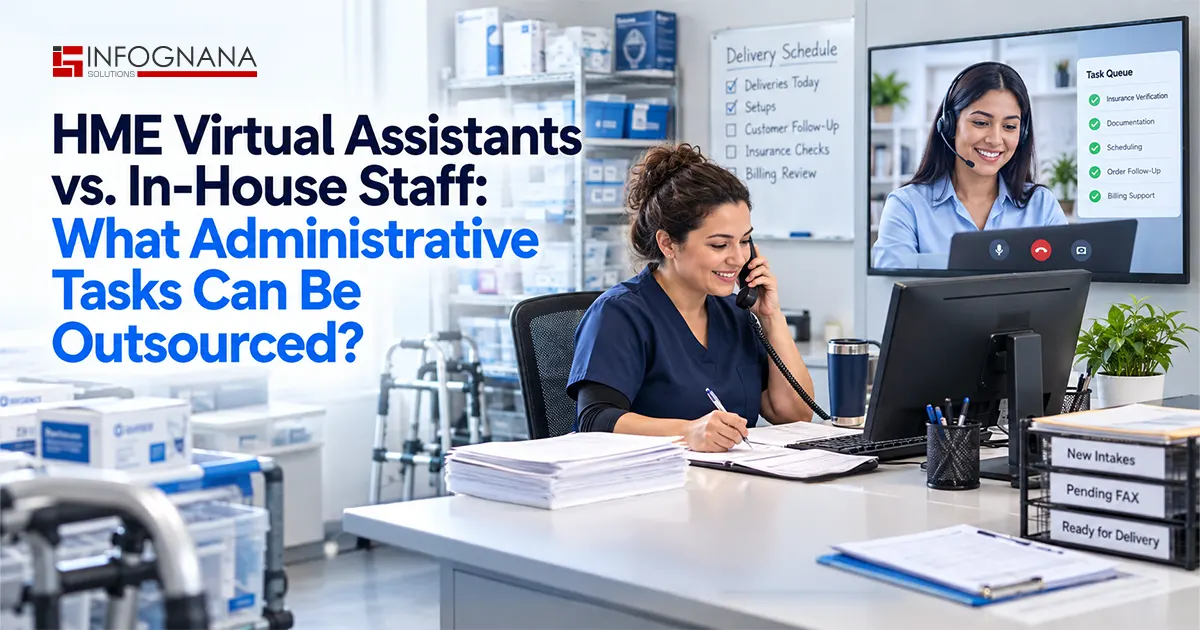
Home Medical Equipment (HME) and Durable Medical Equipment (DME) companies manage a wide range of administrative responsibilities, from patient intake and insurance verification to order processing, documentation, and customer support. As patient volumes increase, handling these tasks efficiently becomes essential for maintaining smooth operations and delivering a positive patient experience.
However, relying entirely on in-house staff can increase staffing costs, create administrative bottlenecks, and make it difficult to manage fluctuating workloads. At the same time, outsourcing every task may not be suitable for activities that require direct supervision, specialized expertise, or in-person interaction.
A healthcare virtual assistant offers an alternative by helping HME and DME companies delegate routine administrative tasks to remote professionals while allowing internal employees to focus on complex cases and operational decisions.
But which tasks can be outsourced, and which should remain with in-house staff?
This blog compares HME virtual assistants with in-house administrative teams, explains which tasks can be outsourced, and provides practical guidance for choosing the right staffing model.
What Is a Healthcare Virtual Assistant for HME and DME Companies?
A healthcare virtual assistant is a remote professional who supports healthcare organizations with administrative, documentation, communication, scheduling, and coordination tasks.
For HME and DME providers, virtual assistants can help manage repetitive activities associated with patient referrals, equipment orders, insurance documentation, and customer service.
Depending on their training and the agreed scope of work, responsibilities may include:
- Patient intake and demographic data entry.
- Insurance eligibility verification support.
- Prior authorization status follow-ups.
- Prescription and medical documentation tracking.
- Order entry and status updates.
- Appointment and delivery coordination.
- Patient and referral-source communication.
- Customer service through phone, email, and chat.
- Updating customer relationship management (CRM) systems.
- Administrative reporting and record maintenance.
A healthcare virtual assistant typically works remotely using approved business systems and established workflows. The in-house team continues to manage activities requiring physical presence, specialized judgment, direct operational control, or other responsibilities that cannot appropriately be performed remotely.
What Is the Difference Between HME Virtual Assistants and In-House Staff?
The main difference is where the work is performed, how the team is managed, and how responsibilities are allocated.
In-house staff work directly within the organization and may handle administrative tasks, face-to-face patient interactions, equipment coordination, and complex operational responsibilities.
Virtual assistants work remotely and can take ownership of suitable administrative workflows, helping internal teams manage routine tasks more efficiently.
| Comparison Factor | In-House Staff | Healthcare Virtual Assistant |
|---|---|---|
| Work Location | Office, facility, or operational site | Remote |
| Patient Intake | Handles intake and complex cases | Supports data entry and routine follow-ups |
| Documentation | Reviews and manages records | Tracks missing documents and updates records |
| Insurance Verification | Handles verification and escalations | Supports eligibility checks and documentation |
| Customer Communication | Handles in-person and remote communication | Supports calls, emails, and approved inquiries remotely |
| Equipment Handling | Can inspect, prepare, or physically handle equipment | Generally limited to administrative coordination |
| Staffing Flexibility | May require recruitment and onboarding for additional capacity | Can provide additional remote capacity based on the service arrangement |
| Management | Direct internal supervision | Managed through agreed workflows, service levels, and reporting |
Neither model is automatically better for every organization. The most suitable approach depends on the company’s order volume, administrative workload, staffing budget, technology, and operational requirements.
What Administrative Tasks Can HME Companies Outsource?
Many repetitive administrative activities can be delegated to a trained healthcare virtual assistant when suitable systems, procedures, and safeguards are in place.
1. Patient Intake and Data Entry
Patient intake involves collecting patient details, reviewing referral information, recording equipment requirements, and entering data into approved systems.
When in-house employees spend too much time entering information and updating records, other responsibilities may be delayed.
A healthcare virtual assistant can support:
- Entering patient demographics and contact details.
- Recording referral and equipment order information.
- Updating patient records.
- Identifying missing information.
- Maintaining organized intake records.
- Routing incomplete orders to the appropriate team.
For example, when an HME company receives a high volume of equipment referrals, a virtual assistant can help enter the information and flag incomplete records for follow-up.
This allows in-house staff to focus on exceptions, complex intake requirements, and decisions that require additional expertise.
2. Insurance Eligibility Verification Support
Insurance verification is an important part of the HME and DME workflow. Providers may need to confirm active coverage, review benefits, and identify applicable payer requirements before proceeding with an order.
A virtual assistant can help gather insurance information, access authorized verification systems, record results, and flag discrepancies.
Common tasks include:
- Entering insurance policy details.
- Supporting eligibility checks through approved systems.
- Recording verification dates and results.
- Identifying missing insurance information.
- Tracking outstanding verification requests.
- Escalating discrepancies to the appropriate employee.
For example, if the insurance details provided with a referral do not match the available records, the virtual assistant can flag the issue and coordinate the required follow-up.
Final coverage decisions should be based on verified payer information and applicable plan requirements.
3. Prior Authorization Follow-Ups
Certain HME and DME products require prior authorization depending on the payer, plan, and equipment involved.
Authorization workflows may require repeated status checks, documentation collection, and communication with insurance companies and referring providers.
A healthcare virtual assistant can help manage the administrative side of this process by tracking authorization requests, recording submission dates, monitoring pending cases, and coordinating follow-ups.
For example, if an authorization request is awaiting additional documentation, the assistant can notify the relevant internal team and coordinate with the referral source to obtain the missing information.
Tasks that can often be outsourced:
- Tracking authorization status.
- Maintaining follow-up schedules.
- Recording payer communications.
- Coordinating missing documentation.
- Updating order management systems.
- Escalating delayed or complex requests.
Authorization decisions, clinical judgments, and other responsibilities requiring qualified personnel should remain with the appropriate professionals.
4. Prescription and Medical Documentation Tracking
HME and DME providers often need prescriptions, clinical notes, and other supporting documents before equipment orders can proceed.
Missing documents can create delays and require repeated communication with physicians, clinics, and other referral sources.
A virtual assistant can maintain document checklists, track outstanding records, send approved follow-up communications, and update the order status when documents are received.
For example, if an order requires an updated prescription, the assistant can flag the missing document and coordinate with the referring provider.
This helps reduce the administrative effort required to manage incomplete orders.
However, reviewing clinical appropriateness, interpreting medical information, and making decisions that require professional qualifications should remain with authorized personnel.
5. Order Entry and Status Management
HME and DME companies handle multiple orders at different stages, including referral receipt, documentation review, authorization, fulfillment, and delivery coordination.
A virtual assistant can support order entry, maintain status records, identify incomplete information, and route orders to the appropriate department.
This can help prevent orders from remaining unattended because of missing updates or unclear handoffs.
For instance, when an order is ready for the next stage, the assistant can update the approved system and notify the relevant team according to established procedures.
6. Patient and Customer Support
HME and DME companies regularly receive calls and messages about equipment availability, delivery schedules, order progress, documentation requirements, and general service inquiries.
A healthcare virtual assistant can handle approved routine inquiries through phone, email, or chat.
Responsibilities may include:
- Responding to general service questions.
- Providing documented order status updates.
- Coordinating delivery appointments.
- Routing technical equipment questions to qualified personnel.
- Recording customer interactions.
- Escalating complaints or urgent concerns.
For example, a patient calling to check a delivery date may receive an update from the virtual assistant based on the latest information in the company’s system.
Questions involving clinical advice, equipment safety, emergencies, or other sensitive matters should be escalated through the organization’s designated procedures.
7. Appointment and Delivery Coordination
Equipment delivery often requires coordination between patients, caregivers, warehouse personnel, drivers, and customer service teams.
Virtual assistants can support scheduling and communication by confirming appointments, updating delivery details, recording changes, and notifying the appropriate internal team.
These activities can help reduce missed communications and scheduling confusion.
Physical equipment preparation, inspection, installation, and delivery should remain with appropriately trained on-site or field personnel.
8. CRM Updates and Administrative Reporting
Accurate records help HME and DME companies monitor patient inquiries, referral activity, pending orders, and customer service performance.
A healthcare virtual assistant can update CRM records, maintain contact information, document follow-up activities, and prepare routine administrative reports.
For example, an assistant can compile a daily summary of pending referrals, incomplete documentation, and orders awaiting follow-up.
This gives managers better visibility into administrative workloads without requiring internal staff to spend excessive time preparing reports manually.
Which Tasks Should Remain With In-House Staff?
Although many administrative activities can be outsourced, some responsibilities require physical presence, direct supervision, specialized qualifications, or access that should not be delegated without appropriate controls.
The following tasks generally require in-house or appropriately qualified personnel, depending on the organization and applicable requirements:
Physical Equipment Handling
Equipment inspection, cleaning, preparation, installation, and physical delivery require personnel with the appropriate training and access to the equipment.
Clinical Decisions
Assessing clinical appropriateness, interpreting medical information, and providing clinical recommendations should remain with qualified healthcare professionals.
Complex Payer or Compliance Decisions
Complicated reimbursement disputes, sensitive compliance matters, and decisions requiring specialized knowledge should be handled by appropriately authorized personnel.
Staff Supervision and Operational Management
Internal leaders should retain responsibility for setting priorities, approving policies, managing staff, and overseeing business performance.
Sensitive Escalations
Clinical concerns, urgent patient issues, serious complaints, and equipment safety problems should follow established escalation procedures and reach the appropriate qualified team.
The distinction is not simply between remote and in-house work. Some specialized tasks may be performed remotely by qualified professionals, while routine administrative work can be outsourced only when the organization has appropriate procedures, permissions, and oversight.
HME Virtual Assistants vs. In-House Staff: Cost and Productivity Considerations
Staffing costs are an important consideration for HME and DME businesses, especially when administrative workloads increase.
Hiring in-house employees can involve recruitment, salaries, benefits, training, office space, equipment, and ongoing management. Outsourcing can change how these costs are structured, depending on whether the provider charges hourly, monthly, or through another service arrangement.
However, the lowest hourly rate does not necessarily represent the lowest overall cost.
Companies should compare the total cost of each model against the work completed, quality standards, management requirements, and business outcomes.
| Cost or Productivity Factor | In-House Staff | Outsourced Virtual Assistant |
|---|---|---|
| Recruitment | Managed internally | Often managed by the service provider |
| Training | Internal onboarding and supervision | Requires workflow-specific training and coordination |
| Work Capacity | Depends on internal staffing | Can be adjusted according to the service arrangement |
| Technology | May require company-provided equipment and licenses | Depends on the provider's setup and access requirements |
| Management | Direct employee supervision | Requires clear instructions, quality checks, and service-level monitoring |
| Scalability | May require additional recruitment | May allow more flexible capacity adjustments |
| Operational Control | Direct organizational control | Managed through agreed responsibilities and procedures |
Before choosing a model, estimate the cost per completed task, error rate, processing time, management effort, and overall impact on operational efficiency.
Benefits of Using a Healthcare Virtual Assistant for HME and DME Operations
Integrating a healthcare virtual assistant into administrative workflows can provide several benefits.
Reduced Administrative Backlogs
Delegating routine data entry, documentation tracking, and follow-ups can help teams manage high volumes of work more consistently.
Improved Workflow Efficiency
Standardized procedures and clearly assigned responsibilities help reduce unnecessary handoffs and repeated administrative work.
Better Visibility Into Pending Orders
Regular status updates and organized records help managers identify bottlenecks and prioritize outstanding tasks.
More Time for Complex Cases
Internal employees can spend more time on complex payer issues, operational decisions, and patient concerns when repetitive tasks are handled by trained support staff.
Flexible Administrative Capacity
Outsourced support can help organizations manage workload fluctuations without immediately expanding their internal workforce.
Improved Customer Communication
Consistent handling of routine calls, messages, and status inquiries can help patients and referral sources receive timely updates.
These benefits depend on the quality of training, integration, workflow design, data accuracy, and ongoing performance monitoring.
How to Choose the Right Healthcare Virtual Assistant Services
Selecting a virtual assistant provider requires evaluating more than cost and staffing availability.
HME and DME companies should look for a provider that understands healthcare administrative processes and can work within established operational and privacy requirements.
Consider the following factors:
- Healthcare workflow experience: Familiarity with patient intake, order processing, insurance verification support, and documentation tracking.
- Communication skills: Ability to communicate professionally with patients, referral sources, and internal teams.
- Technology compatibility: Familiarity with the relevant systems and ability to work through approved access methods.
- Data security: Appropriate confidentiality procedures, access controls, and safeguards for patient information.
- Defined responsibilities: Clear guidelines for routine tasks, approvals, and escalation.
- Performance measurement: Reporting on completed work, accuracy, turnaround times, and pending tasks.
- Scalable support: Staffing arrangements that fit current requirements and future growth.
For US healthcare operations, organizations should assess applicable HIPAA obligations, vendor agreements, and safeguards before permitting access to protected health information.
How Infognana's Virtual Assistant Services Can Support HME and DME Companies
HME and DME providers need reliable administrative processes to manage patient information, documentation, order updates, and customer communication.
Infognana’s Virtual Assistant Services provide a relevant option for businesses looking to delegate suitable administrative tasks and improve day-to-day operational efficiency.
Depending on the agreed scope of work, virtual assistant support can help organizations manage data entry, maintain records, coordinate routine follow-ups, update business systems, and handle approved customer service activities.
For HME and DME companies, a structured outsourcing approach can help distribute administrative responsibilities more effectively while allowing in-house staff to retain control over complex cases, clinical decisions, equipment handling, and operational oversight.
Before outsourcing, businesses should define the tasks to be delegated, establish access permissions, document escalation procedures, and set measurable service expectations.
Conclusion
HME and DME companies do not necessarily need to choose between outsourcing all administrative work and managing every task in-house. A hybrid model can combine the operational control of internal employees with the flexibility of a healthcare virtual assistant.
Routine tasks such as patient data entry, documentation tracking, insurance verification support, prior authorization follow-ups, order updates, customer communication, and administrative reporting may be suitable for outsourcing.
Meanwhile, physical equipment handling, clinical decisions, complex escalations, and responsibilities requiring specialized authorization should remain with appropriately qualified personnel.
By identifying repetitive administrative tasks, establishing clear workflows, and measuring performance, HME and DME providers can improve productivity while maintaining appropriate oversight.
Looking to optimize your HME and DME administrative workflows? Explore Infognana’s Virtual Assistant Services to learn how remote administrative support can help your business manage routine tasks and support operational efficiency.